Slow motion is a frame you can still ask for
To slow down a splash on film you need a faster camera. In animation you need a splash that can still tell you where every drop is.
One leap, four times
A sports replay can slow a jump down because the camera shot it at hundreds of frames a second: there are frames to spare. A drawn animation has none. Twenty-four drawings make a second, and spreading that second over ten means each drawing stays up ten times as long, or someone draws the rest.
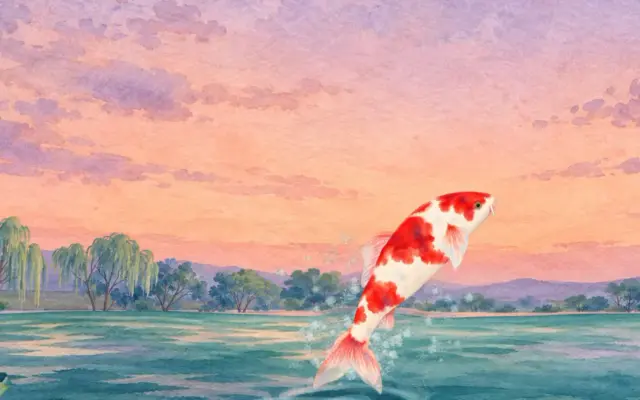
The film below is one leap of a koi, played four times: at speed; again, slowing until it hangs at the top of its arc; held there while the shot pushes in; and run backwards until the water is still. It was made once, at speed. The other three are the same leap with its clock changed.
That is the point of this post. Slow motion, a freeze and a reverse are cheap when motion is computed rather than drawn, because a computed moment can always be asked for again. Only what was drawn once needs in-betweens.
Exported from the Keyframe editor as it is. Twelve seconds, no sound.
The leap has its own clock
The leap lives in a composition of its own, under four seconds long. In the film it is a single layer, and that layer's Time Remap (opens in a new tab) says, for each frame of the film, which frame of the leap to show. At speed, film frame 30 shows leap frame 34. In the slow part, film frame 100 shows leap frame 21.3. From film frame 200 to 250 every frame shows leap frame 28.
The curve is the whole edit. A slope of one is real time, a shallow slope is slow motion, a flat stretch is a freeze and a falling slope runs the leap backwards. Easing into the flat stretch is what makes the koi glide to a stop instead of halting.
Every drop can be asked for again
Nothing in the leap is a stored run of pictures. The koi swims on a chain of five bones, the back three following the front through Secondary Motion (opens in a new tab). The splash is two Particle World (opens in a new tab) layers drawing painted drops. The rings on the water come from Wave World, and the lotus leaves and reeds lean on handles pinned at their roots. Each is worked out from the start of the leap, the same way every time.
So asking for leap frame 28 a fiftieth time gives the same drops in the same places, which is all a freeze needs. Running the clock backwards is only asking for the frames in the other order: the drops fly back into the pond and the rings close up, because every frame is computed from the beginning, not from the frame shown before it.
- The four parts

Between two frames
Slow motion asks for moments between frames, such as leap frame 21.3. The rig answers exactly: a bone has an angle at any instant. A splash is stepped a whole frame at a time, so between frames it shows the last whole one, and played slowly its drops would hop.
The smooth in-betweens come from the film layer's Frame Blending, set to Pixel Motion (opens in a new tab). It renders the two whole frames around the moment, estimates how each pixel moved from one to the other and draws it part of the way. It only works where the clock lands between frames; at speed and in the hold every frame is a whole one and nothing is blended.
Where it shows
Pixel Motion guesses, and it guesses well when things move a little between two frames. The koi's tail swings a long way in one frame, so in the fast end of the reverse the guess sometimes leaves a faint second tail. The cure is more real frames where it matters: a leap built at a higher frame rate, or a reverse that runs slower through the tail's fast strokes.
The pictures stay what was painted. The koi is one side view bent along its spine; however slowly it turns, it cannot roll to show its back. A frozen moment is also only as good as the frame it freezes: a held splash shows exactly the drops that frame had, no more.
Decide the timing last
Build the motion at speed and get it right there, a leap that reads in real time. Then put its clock on a curve and choose where to linger. When everything in it can be asked for again, changing your mind costs a new curve, not new drawings.