Depth is where a picture stands, not where it sits in the stack
Twenty-nine flat pictures, no 3D models, and a camera that walks between them with a fawn.
A camera inside a pop-up book
Open a pop-up book and the flat pages stand up into a scene. A cottage lifts off the spread, trees fold up along a path, and the sky is just a card at the back. Every piece is still printed paper, yet you can lean in and look between the trees. Nothing in it is three-dimensional except where each piece stands.
The usual way to fake depth with flat art in an animation tool is to stack the pictures and slide them at different speeds. That parallax holds while the camera moves sideways. It breaks as soon as the camera turns, moves forward between the pieces, or something has to walk behind one tree and in front of the next. At that point the stack's order is the wrong order for half of the shot, and someone has to fix it by hand.
The film below takes the pop-up book at its word. Each flat picture stands at a real place in one shared 3D space, and the camera walks among them. Which piece hides which, how fast each one slides past, what is in focus and where the shadows fall all follow from where things are. No layer order was set by hand.
Exported from the Keyframe editor as it is, depth of field and shadows included. Sixteen seconds.
Twenty-nine flat pictures
This is everything the book is made of. Each piece is a flat watercolour on a transparent background, made with an image model outside Keyframe: two pages and a cover, a sky, two ranges of hills, a sun and clouds, seven trees, a cottage, grass, branches, two butterflies and a fawn. Nobody modelled anything in 3D.
- All the pieces
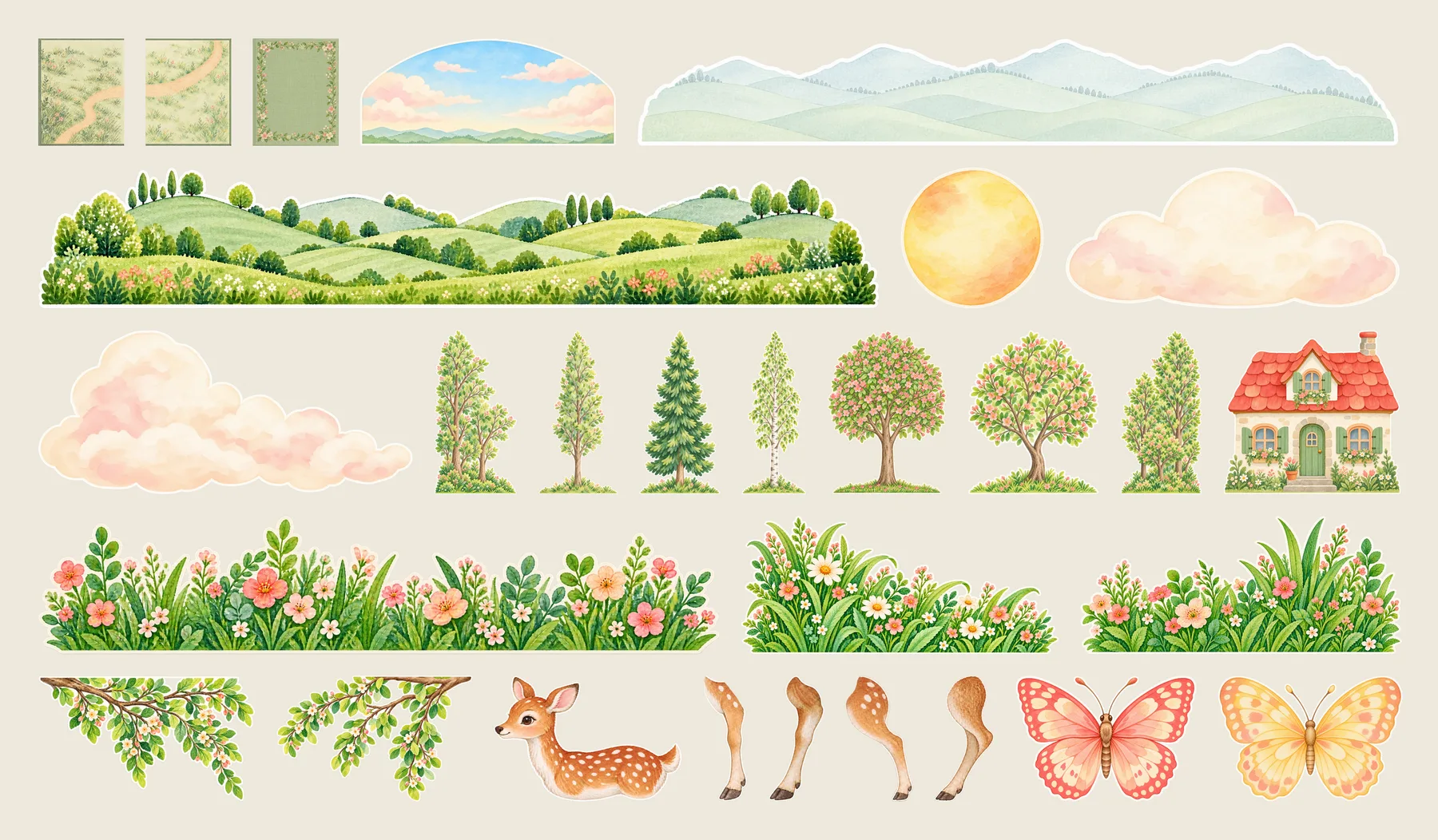
The fawn is the only piece that moves on its own, and it is a paper puppet: a body and four legs, each leg pinned at the hip and swung back and forth as it walks. The near legs sit a sheet's thickness in front of the body and the far legs a sheet behind, so they never fight over which one is on top.
Everything else only stands. Each piece is a 3D layer (opens in a new tab) with a position on the spread and a turn towards the path, folded up from the page along its foot. The sky, the mountains and the hills stand across the spine, so each is cut in two, one half on each page, exactly as a paper engineer would cut it.
Depth, not stacking order
Inside the book the fawn walks the painted path from the front of the left page towards the back of the right one. On the way it passes in front of the cottage, behind a tree, in front of the grass, behind the next tree. With stacked layers each of those moments would need the order changed. Here every pixel of every piece has a depth, and the nearest one wins, so the fawn simply goes where it is and is hidden by whatever stands in front of it.
- Among the paper
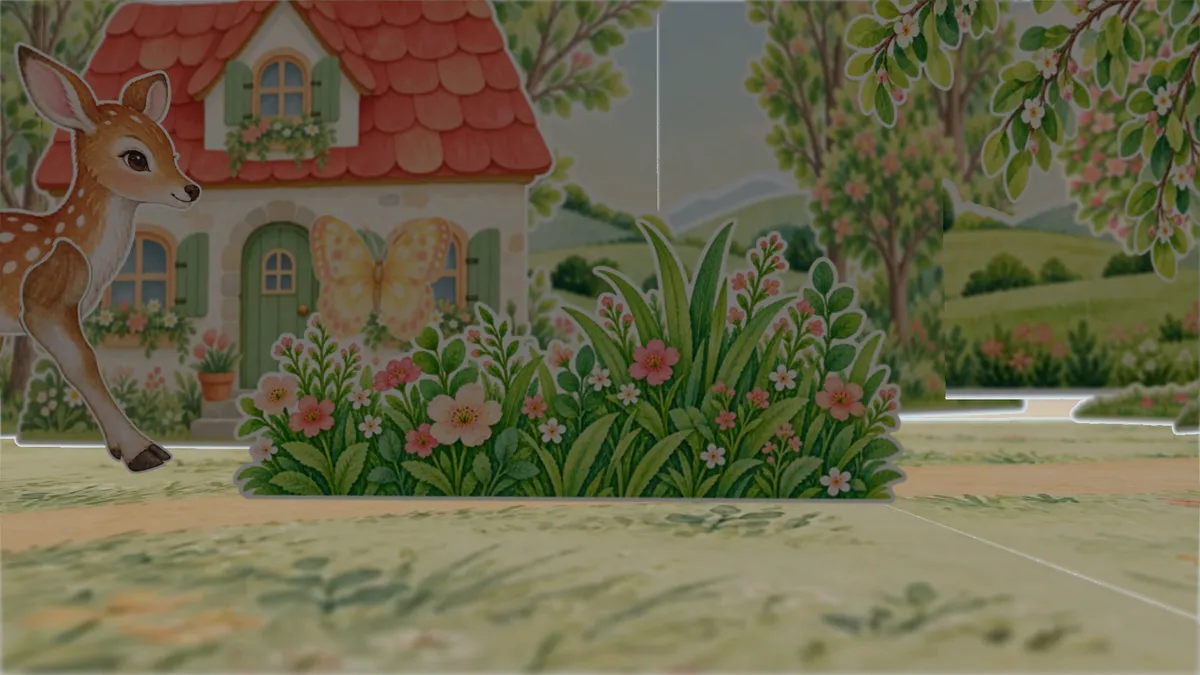
- Between the trees
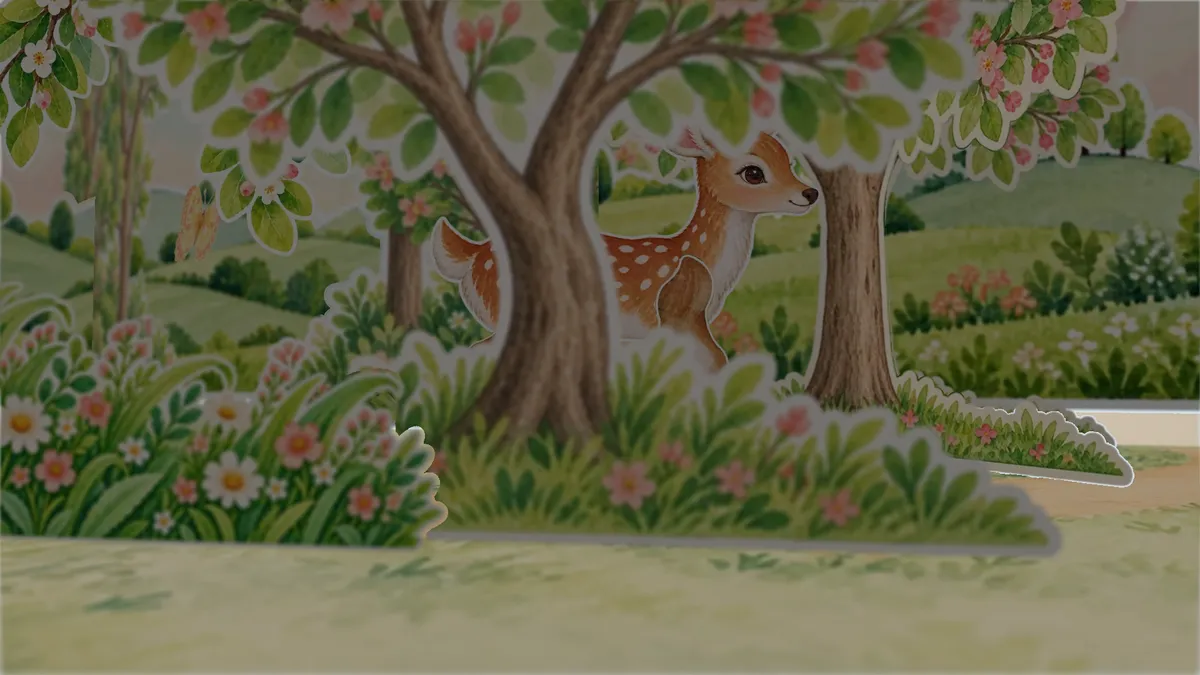
The two big trees go a step further. Each is two cards slotted through each other, the way pop-up trees are built so they stand on their own. The cards cross in the middle, and each one shows where it is the nearer, so the tree reads as a solid from any side. No stacking order can do that, because neither card is in front of the other everywhere.
The rest of what makes it feel like a place comes free with the positions. Grass a hand's width from the lens slides past fast while the hills at the back barely move. The camera's depth of field keeps the fawn sharp and softens the grass in front of it, each pixel blurred by its own distance from the focus. A low morning light behind the book throws each piece’s shadow across the page and onto its neighbours.
The pull-back
Then the camera rises above the treetops and pulls back, and the trick shows itself. The sky was a card at the back of the spread. The woods along the edges were flats, like the wings of a theatre stage. The whole world is a book lying on a table, its shadow stretching across the tabletop.
- The book on the table
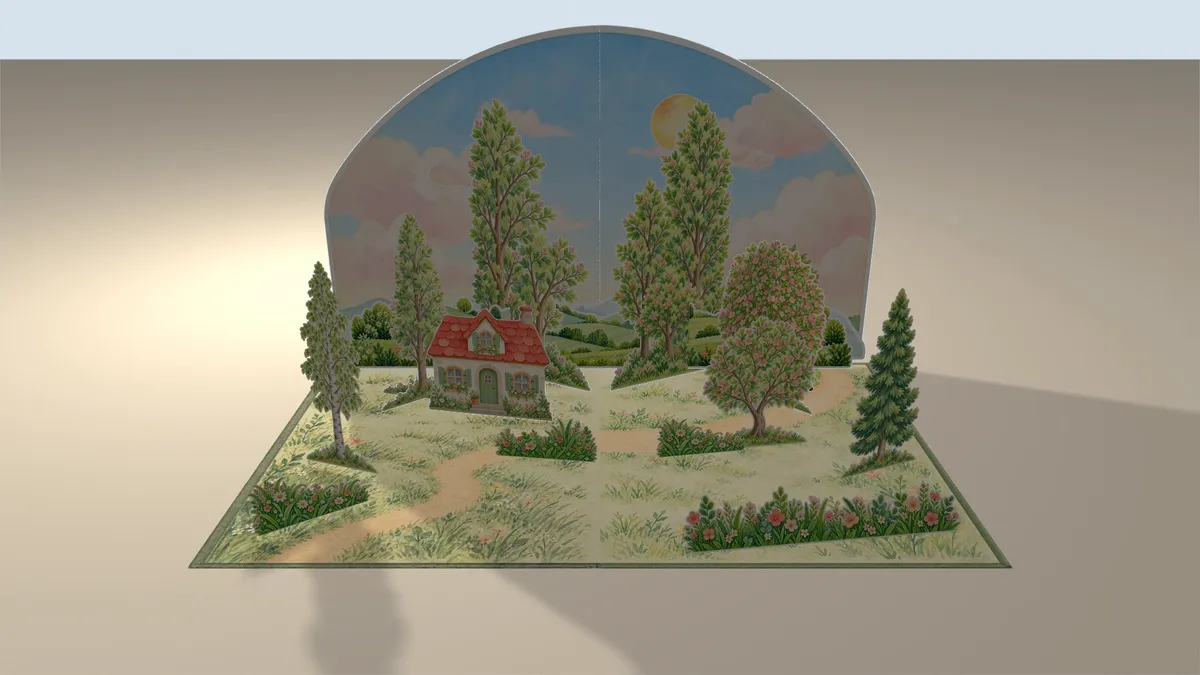
- Closing
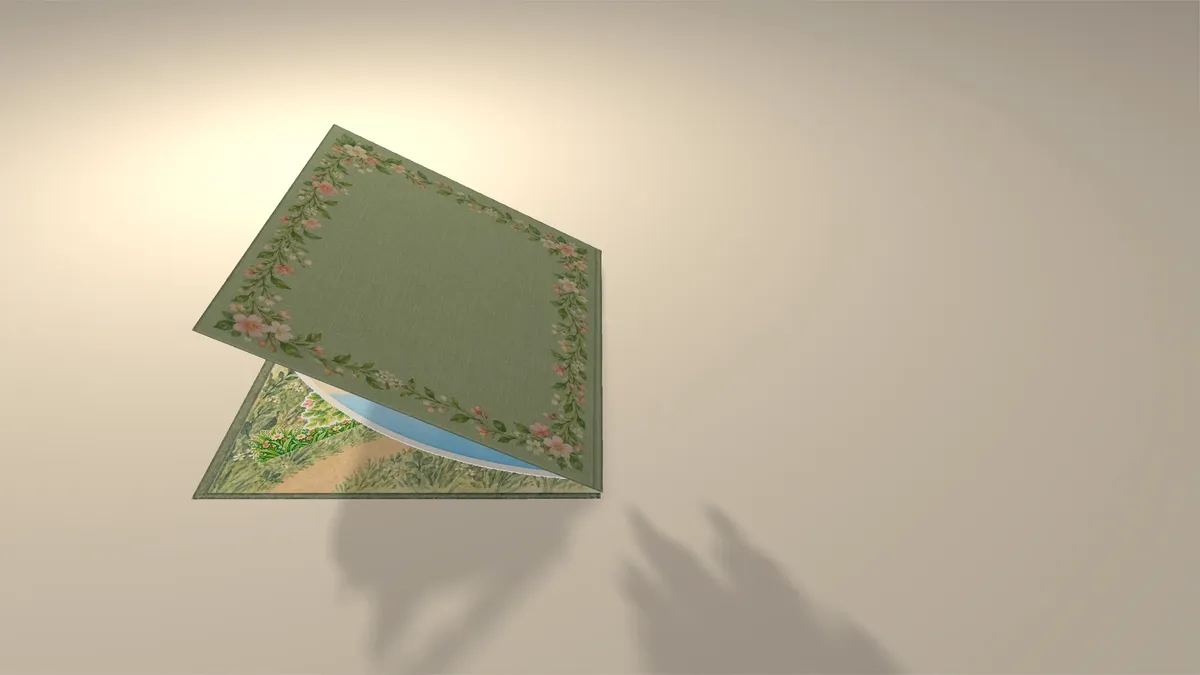
Then the pieces lie down, front to back, each on the fold along its foot, and the cover swings shut over them. Which way each piece folds is worked out from where it stands: it goes down towards the side where more of it lands on its own page, so nothing sticks out of the closed book. The pieces that stood across the spine fold with their own halves of the book.
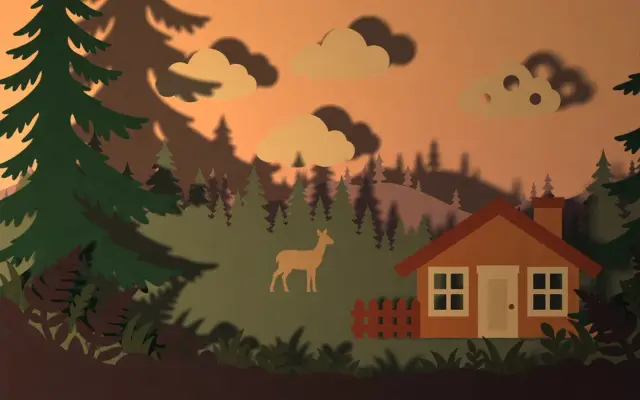
Lights and shadows on flat sheets have a page of their own, with a paper-cut cabin lit from both sides.
What paper cannot do
Paper has no thickness, and the film is shaped around that. Seen edge-on, a card vanishes into a line, so a paper puppet walking straight away from the camera turns into a sliver. That is why the camera tracks the fawn from its side rather than following behind it. It is also why the trees are crossed cards: a single card tree disappears when the camera passes its edge.
A card also has only one picture. From behind, a 3D layer shows its front mirrored, the way light comes through a sheet of paper. A real pop-up book has the same problem and solves it the same way: the reader looks from the front. Here the camera never goes behind the pieces it shows.
Some of it is honest cheating. The branches that frame the view near the lens hang in the air, attached to nothing, and fade out as the camera starts to rise, before the pull-back would show them floating. And depth of field had a fault this film found: where a blurred card's edge spread past its outline, the blur was sorted by the card's middle rather than its edge, which drew thin bright lines over the foreground. It was fixed before this film was exported.
When something has to turn all the way round in front of the camera, flat cards are the wrong tool. A turning object needs a real 3D model, and Keyframe can load one and light it in the same space as the cards. For a scene the camera looks into, the cards were enough.
Flat art is often enough
Every frame of this film is twenty-nine flat pictures. What made them a place is that each one has a position: where it stands, which way it faces and how far it is from the camera. Once those are true, the sorting, the parallax, the focus and the shadows stop being things to animate and become things that happen.
That is the case for building depth from flat art by placing it rather than ordering it. You keep the pictures exactly as they were drawn, and the space comes from where they stand.