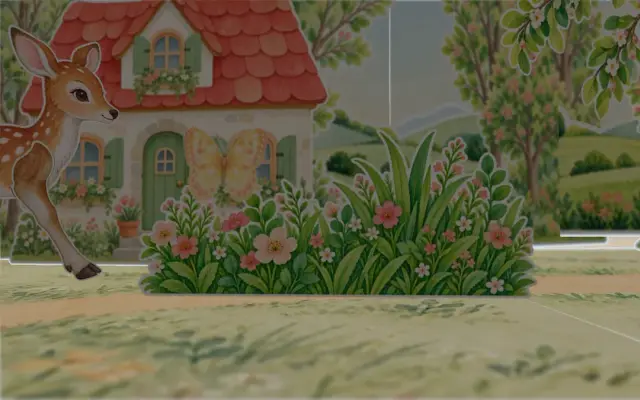
Keep the painting facing the camera
One straight push, a dozen flat paintings, and a window the camera goes through without the painting ever turning.
Into the lit window
A house stands at dusk behind its garden fence, one window lit upstairs. The camera pushes towards it, keeps going, and passes through the window into a small room where a woman is writing at a desk. Twelve seconds, one straight move.
Nothing in the shot is a 3D model. It is a dozen flat paintings, each standing at its own distance from the lens, and every one of them faces the camera squarely for the whole move. That is the point of this post: as long as the painting keeps facing the camera, the camera can push deep into it, and it still looks painted.
We came to that the long way. The first attempt bent a painting around 3D geometry, and it stopped looking like a painting.
Exported from the Keyframe editor as it is. Twelve seconds, no sound.
The first try: a painting on boxes
The obvious way to push into a painting is to give it a shape. Matte painters call it camera projection (opens in a new tab): block the scene out with simple 3D shapes, paint one frame, and cast the painting back onto the shapes from the camera that saw it. Our first version was a watercolour street built that way, grey boxes for the houses and the painting projected over them.
It held for the first few steps and then came apart. A wall that runs along the street, away from the lens, covers a long stretch of the scene but only a thin strip of the painting, so as the camera walks along it that strip is pulled out over the whole wall (panel 3 of the sheet below). The boxes’ edges came through as hard straight lines. What should have looked like a painting looked like the textured level of an old game, and we threw it away.
Projection is the right tool for a small move inside a painted frame. A long push is not a small move.
Multiplane: cards that face the lens
The older answer comes from cel animation. A multiplane camera (external website, opens in a new tab) shoots down through several sheets of glass, each holding part of the painting at a different distance from the lens. When the camera moves, the near sheets slide past faster than the far ones. Each sheet stays flat and square to the lens, so the painting is never bent or stretched.
This shot is built the same way. The outside is one painting split into six layers: the sky, far hills, the village, the house, the garden, and a tree and a street lamp in front. Each stands at its own distance, from thirty thousand pixels away for the sky to fifteen hundred for the tree, and all of them face the camera.
- How the shot is made
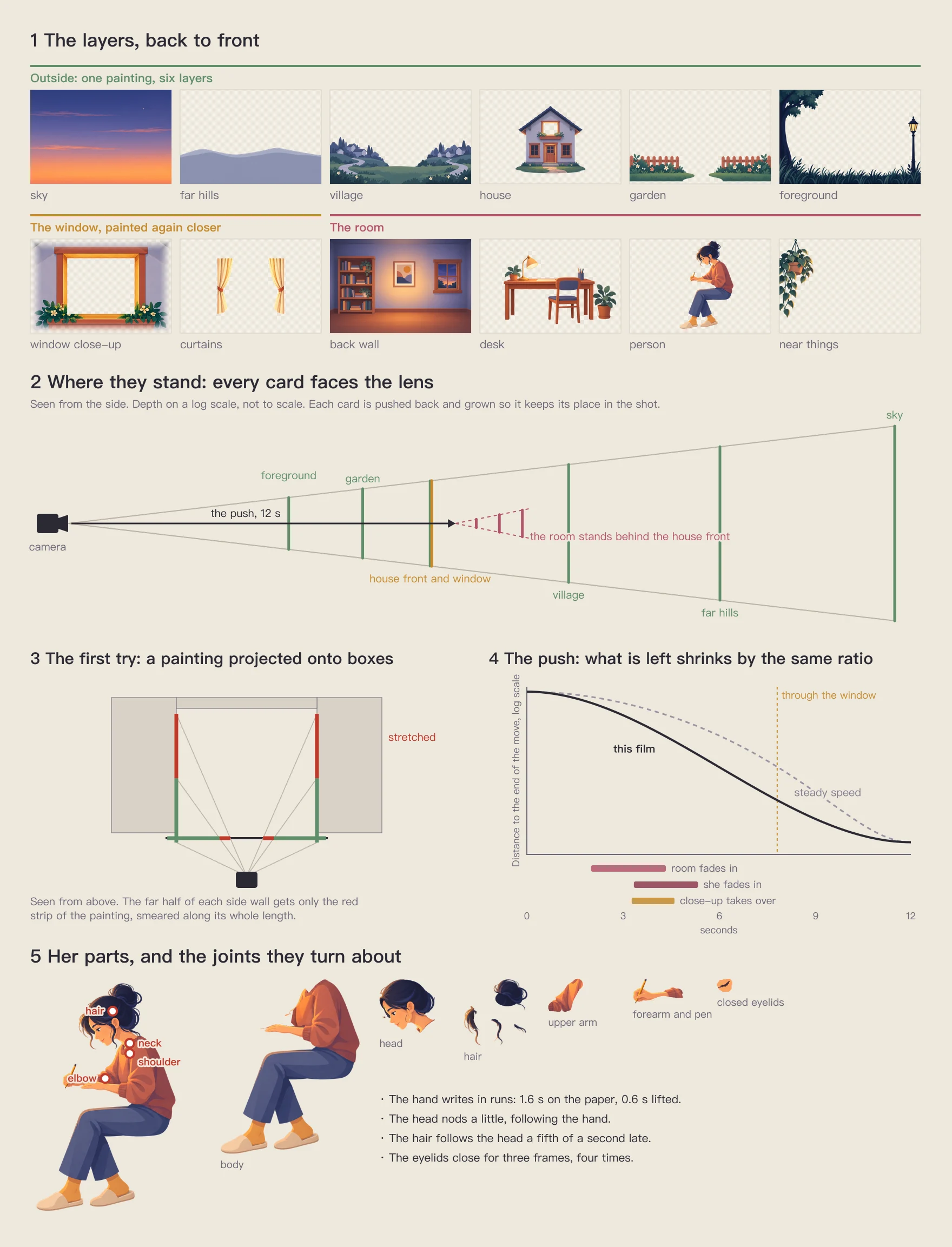
Spreading a painting out in depth has a catch. Push a card back and it shrinks, and the composition you painted falls apart. Each card has to grow in proportion as it goes back, so that the first frame’s camera sees it cover exactly the pixels it covered before. Toon Boom Harmony has a tool for this, Maintain Size (external website, opens in a new tab), and Keyframe does the same when you arrange layers in depth (opens in a new tab). The first frame looks exactly like the painting; only when the camera moves do the cards part.
Through the window
A push this deep runs into resolution. In the house painting the lit window is a small part of the frame; by the time the camera reaches it, it fills the screen. Enlarged that far, the house’s own window would be a blur.
So the window is painted twice. A second picture shows the same window up close, with its frame, flower boxes and the wall around it, and the curtains have a layer of their own. While the small window grows from about a quarter to two fifths of the screen’s height, the close-up fades in over it, aligned to the same opening, and the camera passes from one painting to the next without a cut. The close-up came back from the image model a little bluer than the house’s wall and had to be colour-matched, and its first window did not match the far one and was redrawn.
Behind the window is the room: a back wall, a desk, the woman, and a hanging plant close to the lens. Its cards are framed for the last frame, so from far off the room is wider than the window, wider even than the house front it stands behind (panel 2). A mask (opens in a new tab) on each room layer keeps it inside the house’s solid front until the camera is close enough for the window frame to hide its edges, and then the mask opens.
Far off, only the window’s light shows: a warm card fills the opening. As the camera comes closer the room fades in over that light, and then she does. The garden and the tree fade out just before the camera would pass through them.
Making her move
A figure that stays still at the end of a push reads as a picture hanging on a wall. So the woman is not one card but six: her body, head, hair, upper arm, forearm with the hand and pen, and a pair of closed eyelids. The image model cut them from her picture, each painted whole where another part covers it, and they stand a fraction of a pixel apart in depth so no two share a plane.
Each part hangs from another and turns about a joint: the head on the body, the hair on the head, the upper arm on the body, the forearm on the upper arm. The joints were not placed by eye. Where two parts overlap, the middle of the overlap is the joint; the shoulder is the far end of the upper arm.
The motion is ordinary rotation keyframes. The hand writes in runs, a second and a half on the paper with a small quick wobble, then lifts for a moment. The head nods a little, just after the hand. The hair follows the head a fifth of a second late, as loose hair does, with a slow sway of its own. In the second half she blinks four times, the closed eyelids showing for three frames each. It is a small amount of motion, and enough: when the push stops, the room is lived in.
An even push
A camera moving at a steady speed does not look steady. What it heads for grows on screen in proportion to one over the distance left, so it creeps for most of the move and then rushes at the end.
Here the distance left shrinks by the same ratio every frame instead. The window then grows by the same factor every frame, and the push feels even all the way, eased only at the start and the end. Panel 4 of the sheet puts the two on a log scale: the steady push hangs back and then drops, while this one comes down in a long, even slope. The fades and the window’s hand-over are timed along the same curve, all of them before the camera passes through the window just before the eight-second mark.
What it cannot do
It only goes straight ahead. Every card can face the lens because the lens only moves along its own line of sight. Turn the camera, go round a corner or look back, and the cards give themselves away as flat sheets standing at angles. A shot that needs that is a job for real 3D, or for a new painting made for the new direction.
The art has to be painted for it. Each group of layers is cut from one painting made from one viewpoint, and whatever a nearer layer hides has to be painted whole behind it: the house behind the garden, the wall behind the woman. The window’s close-up has to match the window in the far painting. None of that comes free from an image model; here it took a redraw and some colour matching.
Some of it is staged. The room exists only through the window, and masks hide it while it would spill past the house. Fading the room and the woman in over the light reads well at this speed, but look for it and it is a little like watching them materialise. And she moves only in the plane of her card: she can nod and write, but she cannot turn to look at the camera.
Let it stay a painting
Flat art does not have to become 3D to move in depth. It has to be placed in depth while staying exactly what it was: a painting seen straight on. Every device in this shot, the cards spread out with their size kept, the window painted twice, the masks and the fades, serves that one rule.
When the camera has to turn, use real geometry. When it only has to go in, keep the painting facing it.
The pop-up book takes the other road: its flat pictures stand at angles, and the camera walks among them.